
Traditional Chinese Landscape Painting Techniques
Inspired by 潘志英 Pan Chih Ying
Demo by Grace Lin
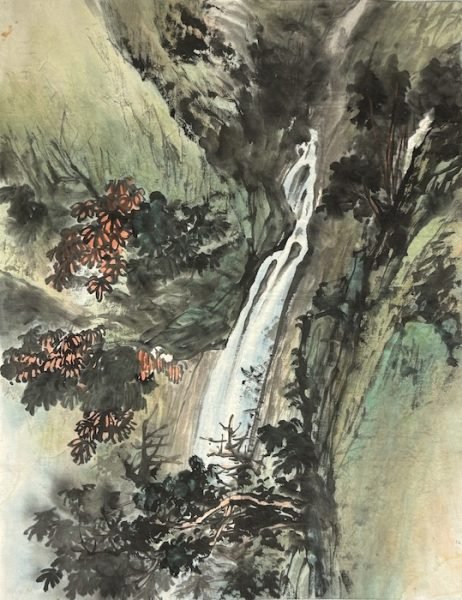
This lesson demonstrates the process of painting a traditional Chinese landscape from a master painting example by my uncle, 潘志英.
From my private lessons, following my demostration step by step, We will gradually build the composition through layered ink techniques, starting from the foreground and developing the rocks, trees, and waterfall with expressive brushwork and ink washes. Then learn how to softly wash colors layer by layer into a traditional ink landscape painting while preserving the beauty of monochrome brushwork.
Techniques Included:
- Traditional rock texture techniques (皴法 — Cūn Fǎ)
- Triangle-dot foliage techniques (三角点法 — Sān Jiǎo Diǎn Fǎ)
- 介 dots technique (介字点法 — Jiè Zì Diǎn Fǎ), including both:
- Boneless technique (没骨法 — Mò Gǔ Fǎ)
- Outline technique (勾勒法 — Gōu Lè Fǎ)
- Waterfall brushwork techniques
- Applying transparent color layers over monochrome ink painting
Traditional Chinese Landscape Painting – 1
Defining the Composition:
Begin by establishing the overall composition and major movement of the landscape.
Lightly indicate the placement of the mountains, waterfall, rocks, and trees. Start developing the foreground first, focusing on the larger rock forms and main tree structures to create a strong foundation for the painting.
Traditional Chinese Landscape Painting – 2
Foreground Tree — Outlines and Branches:
Paint the foreground tree using expressive outline strokes.
Define the trunk and branches with varied brush pressure and ink values to create movement and natural rhythm. Allow the branches to grow organically into the composition.
Traditional Chinese Landscape Painting – 3
Tree Leaves with Triangle Dots (三角点法):
Apply layered triangle-dot brushwork to create clusters of foliage.
Use changing ink values and overlapping brush marks to suggest density, depth, and the texture of leaves within the landscape.
Traditional Chinese Landscape Painting – 4
Tree Leaves with 介 Dots (介字点法 — Jiè Zì Diǎn Fǎ): Demonstrate the traditional “介 dots” foliage technique.
Use controlled, calligraphic brushstrokes to create elegant leaf structures and varied textures, allowing the trees to feel lively, balanced, and integrated within the composition.
(介 — Jiè — suggests something positioned “between” or “connecting,” while 点法 — Diǎn Fǎ — refers to traditional dotting brush techniques.)
Traditional Chinese Landscape Painting – 5
Defining the Waterfall and Rock Texture Techniques (皴法 — Cūn Fǎ):
Establish the waterfall flowing between the rock formations.
Introduce traditional texture-stroke techniques (Cūn Fǎ) to describe the structure, weight, and surface textures of the rocks. Use layered dry- and wet-brush methods to create depth, movement, and atmospheric variation.
Traditional Chinese Landscape Painting – 6
Developing the Waterfall and Rock Textures:
Continue refining the relationship between the waterfall and surrounding rock formations.
Strengthen contrasts between light and dark ink while building dimensional texture through repeated 皴 strokes and ink layering techniques.
Traditional Chinese Landscape Painting – 7
Shrubs on Rocks — Boneless and Outline Techniques:
Paint shrubs and small foliage growing around the rocks using the 介 dots technique (Jiè Zì Diǎn Fǎ). Demonstrate both:
- Boneless technique (没骨法 — Mò Gǔ Fǎ) — painting forms without outlines using expressive ink brushstrokes
- Outline technique (勾勒法 — Gōu Lè Fǎ) — defining forms with contour brush lines before adding tones
These two methods create variation, richness, and harmony within the landscape composition.
Traditional Chinese Landscape Painting – 8
Creating the Final Waterfall Atmosphere:
Use soft ink washes to unify the composition and build variations in value throughout the rocks and trees.
Refine the waterfall by preserving lighter areas for flowing water while deepening surrounding ink tones to emphasize contrast, atmosphere, and spatial depth.
Traditional Chinese Landscape Painting — Leaves Practice with Triangle Dots
Foliage Practice Studies:
Landscape_leaves with Triangle Dots
Practice building leaves using layered triangle-dot brushwork with changing ink density and brush direction.
Traditional Chinese Landscape Painting — Leaves Practice with 介 Dots (Boneless & Outline techniques)
Demonstrate both traditional foliage methods:
- Boneless technique (没骨法 — Mò Gǔ Fǎ) — painting forms without outlines using ink washes
- Outline technique (勾勒法 — Gōu Lè Fǎ) — defining forms with brush lines before applying ink tones
Traditional Chinese Landscape Painting – 9
Applying color layers:
Learn how to softly wash colors into a traditional ink landscape painting while preserving the beauty of monochrome brushwork. This lesson demonstrates how transparent color layers can enrich atmosphere, depth, rocks, trees, and waterfall harmony.
Traditional Chinese Landscape Painting – 10
Unified painting with color layers:
Learn how to softly wash colors into a traditional ink landscape painting while preserving the beauty of monochrome brushwork. This lesson demonstrates how transparent color layers can enrich atmosphere, depth, rocks, trees, and waterfall harmony. Use warm and cool colors to create a sense of depth.